How to Choose Between AWS and Google Cloud: Four Decision Dimensions for Global Teams
Global teams often reduce cloud selection to a single question about price, yet pricing models, network paths and compliance coverage differ between the two providers. This article breaks the decision into four comparable dimensions: cost, network, compliance and ecosystem.
Global teams often compress a complex architecture decision into one question: is AWS or Google Cloud cheaper. The question itself biases the answer. The two providers differ in pricing models, network structure, compliance coverage and ecosystem focus, and the same workload can produce bills whose differences come from entirely different line items. Breaking the decision into comparable dimensions is more useful than memorizing a unit price.
In our day-to-day multi-cloud procurement and migration projects, we have seen many teams choose a provider on unit price, only to discover six months later that egress traffic and cross-region calls were consuming the budget. The four dimensions below are ordered by decision impact.
1. Cost Should Be Measured by Total Cost of Ownership
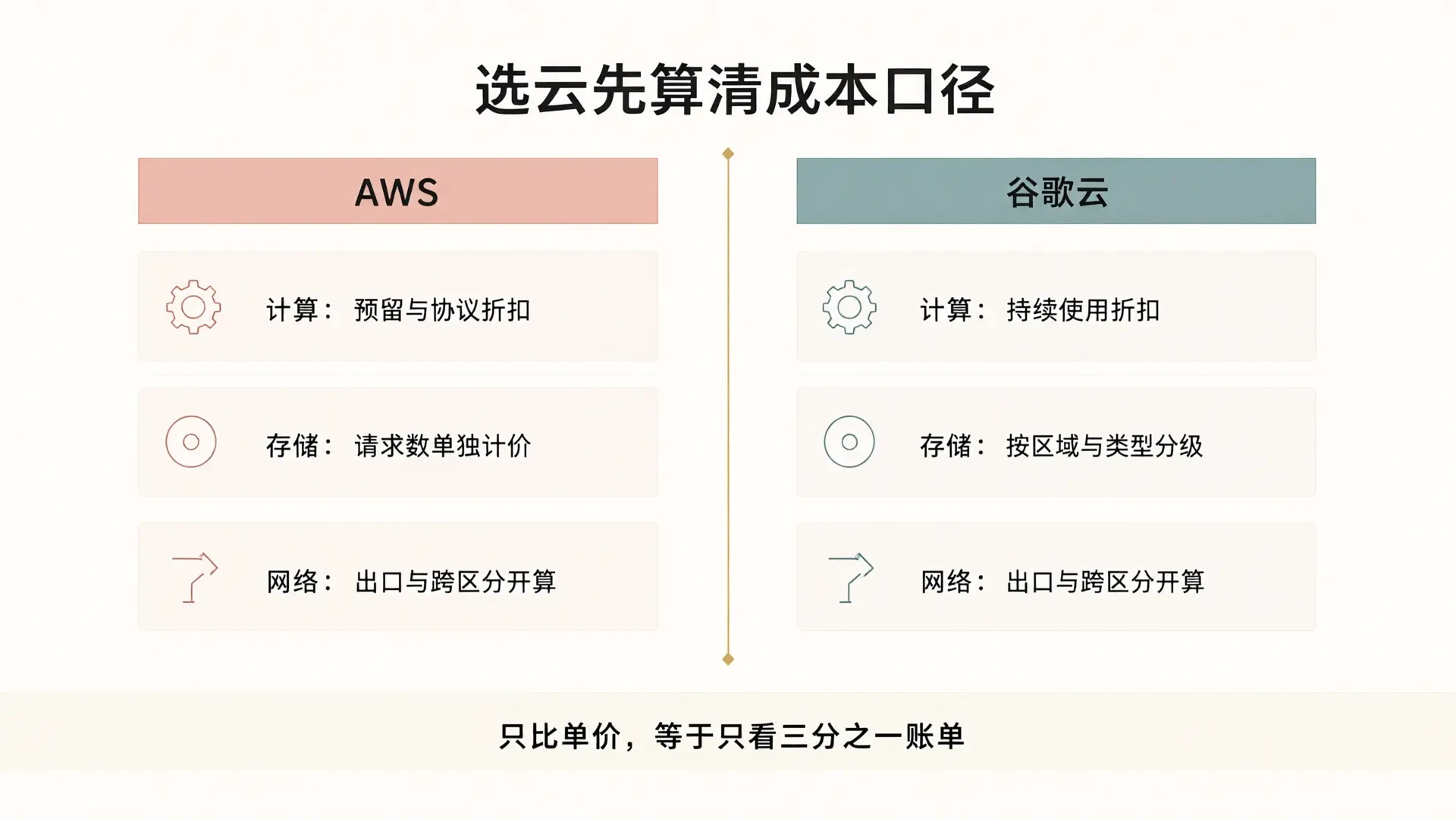
A cloud bill has three cost categories: how compute is billed, how storage and request charges accumulate, and egress costs. Both providers offer on-demand, committed discount and interruptible tiers for compute instances; the difference lies in the conditions for earning discounts and billing granularity. AWS Reserved Instances and Savings Plans price commitment length and usage pattern separately, while Google Cloud's sustained use discounts apply automatically to steadily running workloads. The effective unit price for an always-on instance can differ between the two mechanisms, provided the load curve is stable; for workloads with clear peaks and valleys, interruptible instances and autoscaling often deliver more than any discount.
Network cost is the easier item to underestimate. Both providers bill public egress separately, and the scope for cross-AZ, cross-region and cross-cloud traffic differs. In a typical global architecture, with databases and application servers deployed across regions plus object storage read requests, network-related spending can take a meaningful share of the monthly bill. Comparing instance prices alone covers only part of the picture.
Our first step with clients is usually not a quote but a breakdown of the existing bill by category: compute, storage, network, database and middleware, and which parts are fixed versus caused by architecture redundancy. Only with that baseline does a discount discussion make sense. The same logic applies to first-time cloud adopters: running an architecture cost estimate before launch is cheaper than optimizing afterwards.
2. Network Is About Paths, Not Bandwidth
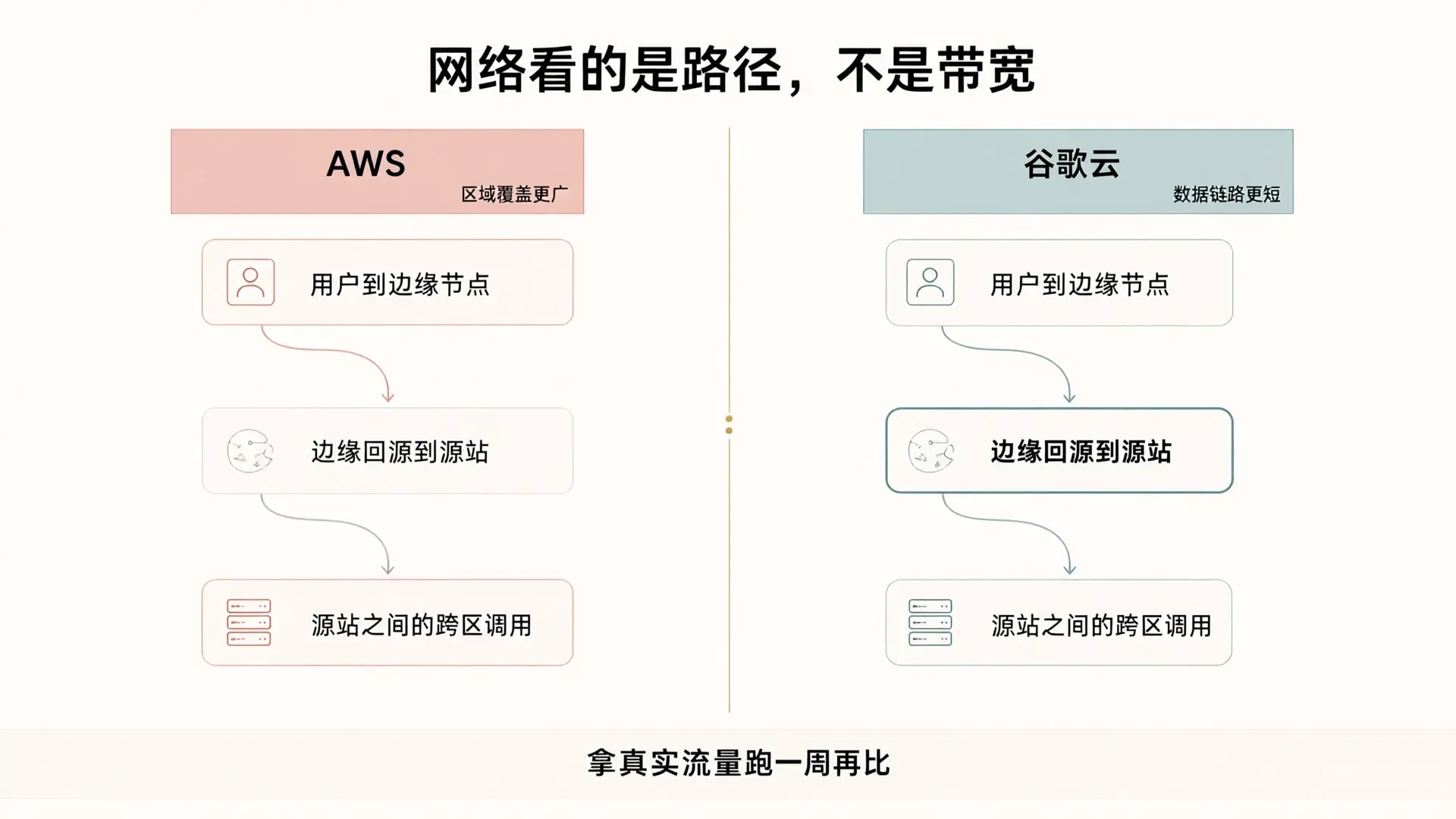
Both providers' global backbones cover major economies; the differences lie in edge node density and cross-region forwarding. For global business, three link segments affect experience: user to edge, edge back to origin, and cross-region calls between origins. The first determines first-screen performance, the second determines origin fetch cost, and the third sets the latency ceiling for data consistency.
Cross-border e-commerce and content distribution teams are most sensitive to first-screen load time, and closer edge nodes raise static asset hit rates. Real-time trading or collaboration teams should focus on the stability of cross-region latency rather than average bandwidth. Google Cloud integrates networking and data tooling more tightly, giving analytics workloads a shorter path to nearby storage; AWS has broader regional coverage and earlier node deployments in emerging markets such as Southeast Asia, the Middle East and South America, offering more room when choosing regions.
There is no universal answer. A practical approach is small-scale replay with real traffic: deploy core pages and APIs on both providers, run probes from target markets for a week, and compare distributions of first-screen time, origin fetch rate and error rate rather than peak speed test numbers. The selection discussion becomes much faster once data is available.
3. Compliance Determines Available Regions
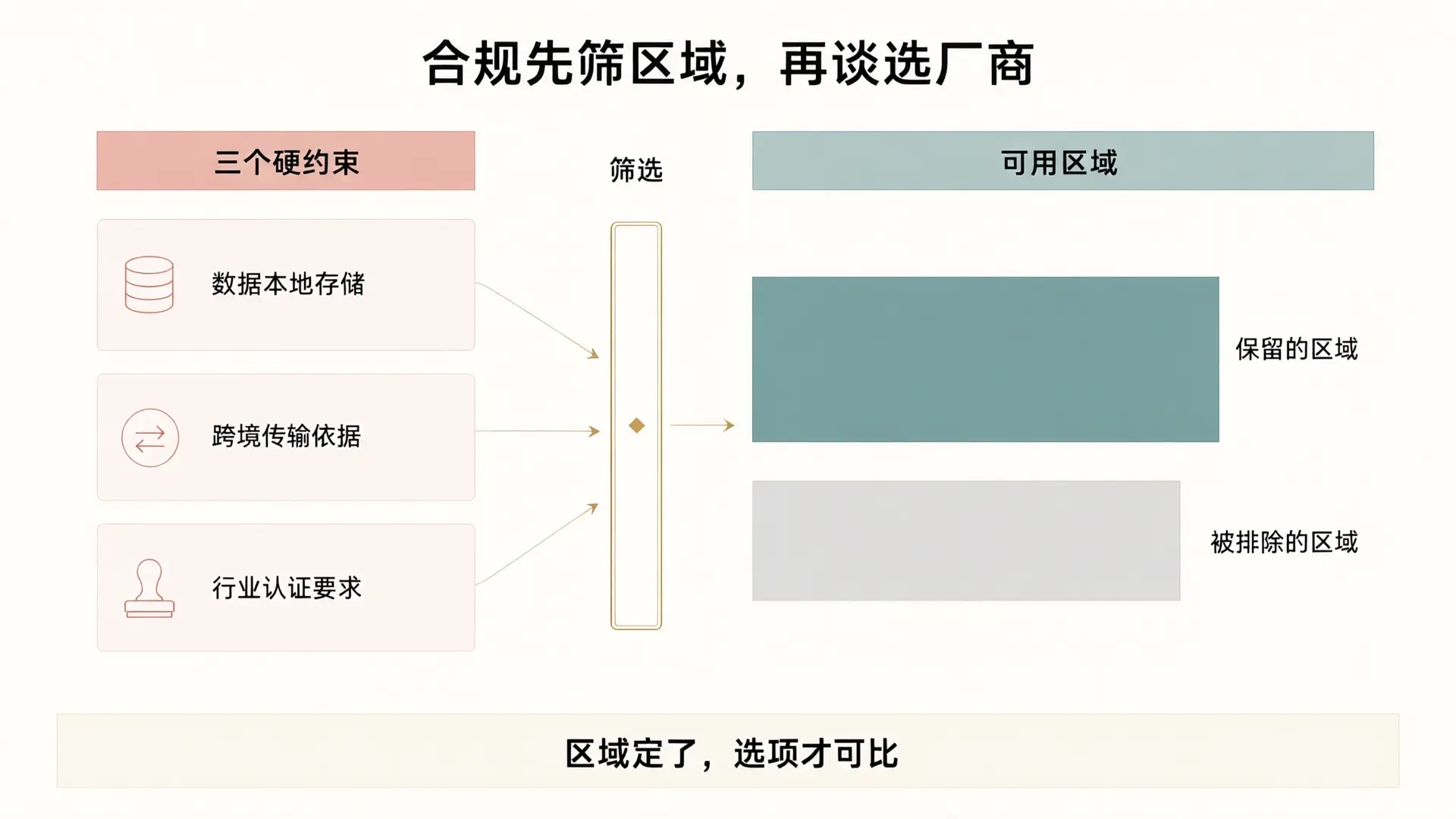
Both providers offer mainstream security certifications; the difference is coverage of specific regions and industry qualifications. Global enterprises need to confirm three things: whether the target market requires local data storage, whether cross-border transfer needs an additional legal basis, and whether industry regulators require specific certifications. European markets have clear constraints on personal data processing, and some Southeast Asian countries require localization of financial and healthcare data. These constraints determine available regions more than provider choice.
An easily overlooked point: compliance cost is not only certifications but also audit trails and configurability of access control. Log retention periods, key management and sub-account permission granularity determine the workload of later assessments. Listing compliance requirements and checking each against both providers' regional and product support is cheaper than retrofitting architecture afterwards.
If a business covers both domestic and overseas markets, deployment is usually split: domestic workloads on a local provider, overseas workloads on AWS or Google Cloud. This combination adds requirements for billing management and operations coordination, which is a practical reason multi-cloud management services exist.
4. Ecosystem and Team Skills Drive Hidden Migration Cost
Managed service maturity and talent availability are two costs that never appear on a quote. AWS has a broader service portfolio, more third-party integration cases and a larger hiring pool; Google Cloud is more coherent in data warehousing, machine learning tooling and container orchestration, so teams already heavily using its analytics products would face rewritten data pipelines when migrating.
Lock-in needs specific assessment. Projects using managed message queues, managed databases and managed functions concentrate migration cost in data export formats and invocation methods; projects using only virtual machines and object storage mainly face downtime windows and traffic fees. Listing the managed services in the current architecture and rating migration difficulty gives a more realistic view than "whole-architecture migration".
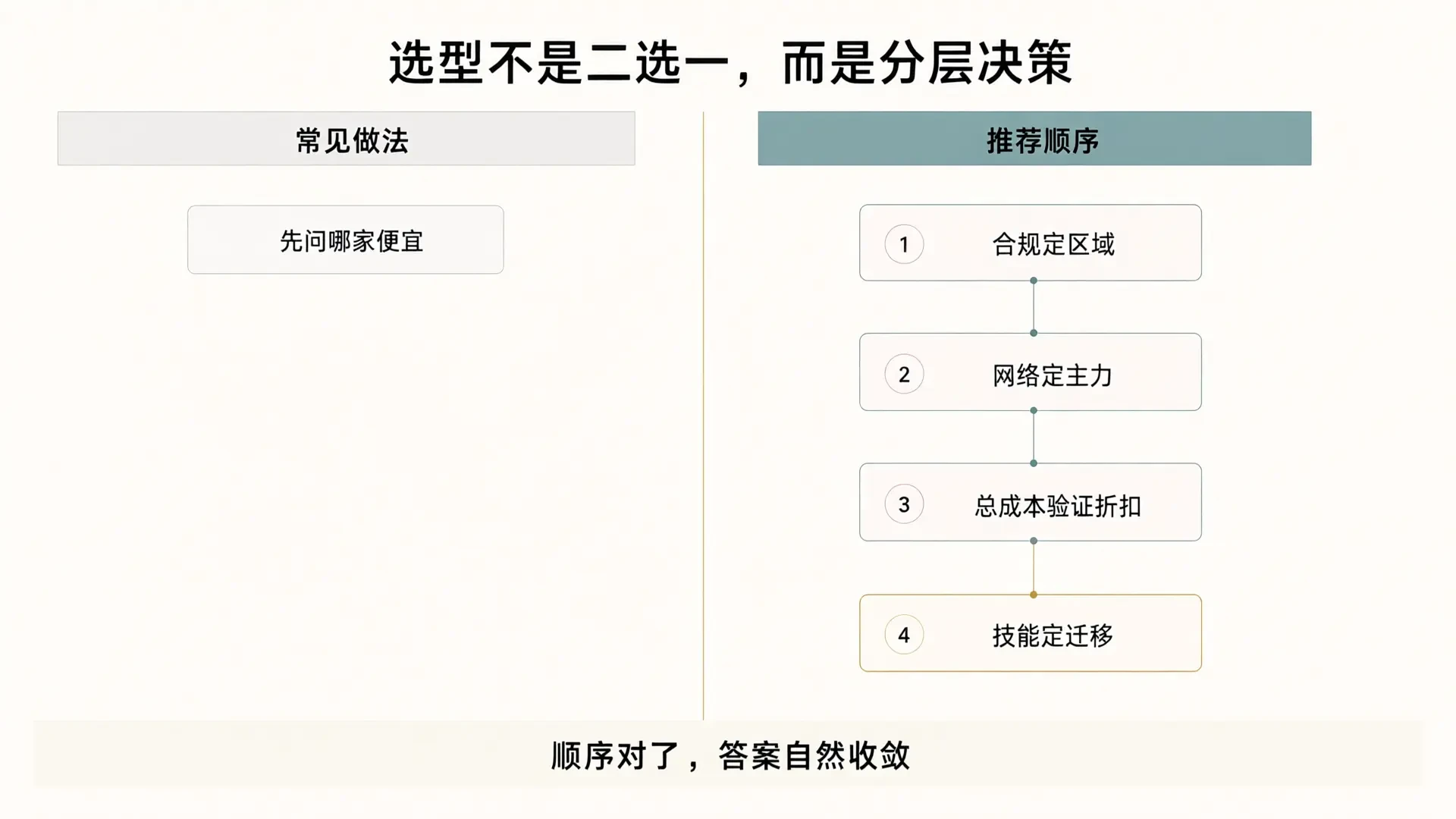
Selection Is Layered, Not Binary
Putting the four dimensions together yields an order: compliance defines available regions, network and business type determine the primary provider, total cost of ownership validates discount options, and team skills assess the migration path. Most enterprises find the answer is not either-or: core business on one provider, analytics and experimental workloads on another, or multi-region disaster recovery within a single cloud.
The cost of multi-cloud is higher management complexity: two account systems, two bills, two monitoring stacks. That is where YizhanBang started. As a multi-cloud management provider, we offer procurement for AWS, Google Cloud, Alibaba Cloud and Tencent Cloud, consolidate scattered bills into one view, and negotiate dedicated discounts based on usage and commitment period; prices are not published on public pages and are quoted after actual usage is calculated. On the migration side we provide architecture assessment, data migration and post-launch operations, with quarterly FinOps reviews that keep budget variance explainable.
For teams making a selection decision, start with one thing: estimate the next twelve months of resource usage and traffic structure, then run both providers' cost models with a unified basis. Estimators produce more than numbers; they show which parts of the architecture keep generating cost. If needed, send us the estimate for review and we will mark discount headroom and architectural redundancy.
Related News


Get Full Report + Free Architecture Assessment
Fill out the form now and our experts will contact you within 24 hours with an exclusive optimization plan